
Pale Pink (#fadadd) Color Information
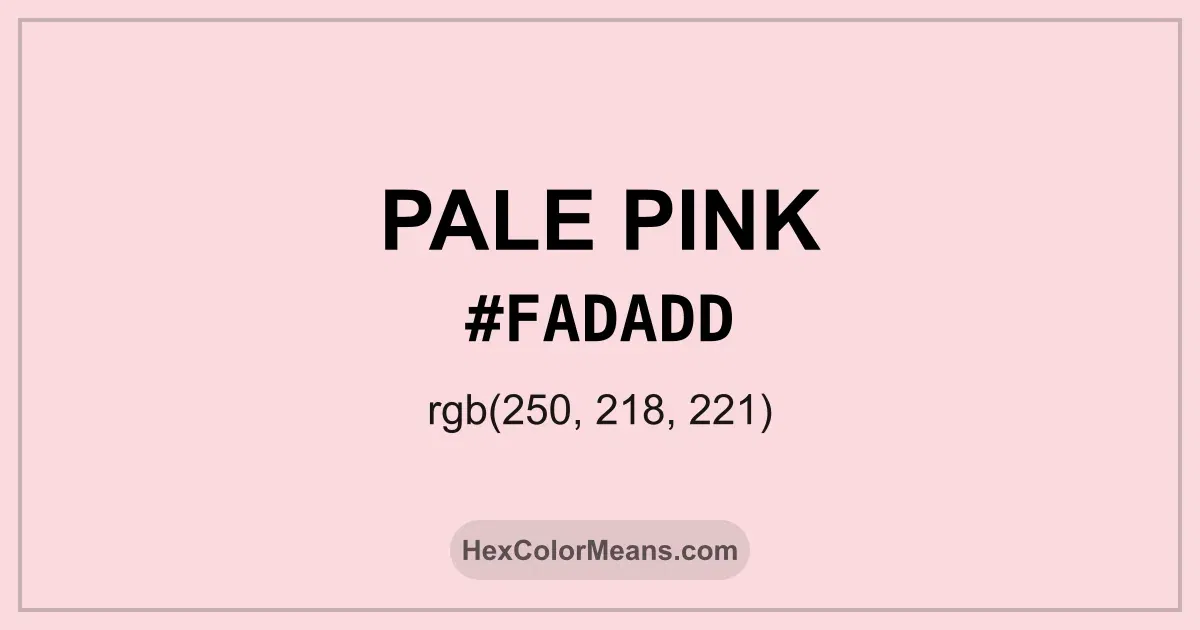
Pale Pink (#fadadd) RGB value is (250, 218, 221). The hex color red value is 250, green is 218, and blue is 221. Its HSL format shows a hue of 354°, saturation of 76%, and lightness of 92%, while the CMYK process values are 0%, 13%, 12%, and 2%.
Colors that pair well with Pale Pink (#fadadd) include Petal Frost (#FFDAE9), Antique White (#FAEBD7), and Aero Blue (#C9FFE5), as they maintain visual balance and harmony, whereas Nyanza (#E9FFDB), Azureish White (#DBE9F4), and Frozen Water (#DFFFFD) tend to conflict with this color due to strong contrast or opposing tonal characteristics.
Pale Pink (#fadadd) Color Meaning
Pale Pink (#FADADD) is a soft, warm shade of pink with delicate pastel qualities. It belongs to the lighter end of the red spectrum, offering gentleness without intensity. Historically, pinks were associated with aristocracy and fashion during the 18th century in Europe. This color evokes calmness, nurturing, and affection. Pale Pink (#FADADD) is ideal for creating serene spaces or conveying warmth in visual design. It supports relaxation while subtly energizing the viewer with emotional softness. In different cultures, pink represents love, care, and celebration. In China, light pink shades symbolize femininity and charm. Pale Pink (#FADADD) also appears in wellness and spiritual practices, linked to heart-centered emotions and empathy, promoting reconciliation and emotional openness.
Color Conversion
Accurate conversions of Pale Pink (#fadadd) across RGB, Hex, CMYK, HSL, and Lab ensure consistent color fidelity across digital, print, and design applications.
RGB Values & CMYK Values
Detailed RGB and CMYK values of Pale Pink (#fadadd) displayed in a horizontal bar provide clear reference for digital and print color accuracy.
RGB Channels
CMYK Ink Density
Color Variations
A full range of Pale Pink (#fadadd) variations, including tints, shades, and tones, provides highlights, depth, and subtle desaturated options for UI design.
Color Harmonies
Harmonious color schemes for Pale Pink (#fadadd) created using the color wheel ensure visually balanced palettes.
Analogous
Colors adjacent on the color wheel (30° apart)
Complementary
Colors opposite on the color wheel (180° apart)
Split Complementary
Three colors using one base hue and the two hues beside its opposite
Triadic
Three colors evenly spaced (120° apart)
Tetradic
Four colors forming a rectangle on the wheel
Square
Four colors evenly spaced (90° apart)
Double Split Complementary
Four colors formed from two base hues and the colors next to their opposites
Monochromatic
Variations of a single hue
Contrast Checker (WCAG)
Luminance contrast ratios for Pale Pink (#fadadd) against standard backgrounds ensure readable, accessible text following Contrast Checker and WCAG 2.1 AA/AAA standards.
Sample Text
This is how your text will look with these colors.
Large Text (18pt+)
Normal Text
UI Components
Color Blindness Simulator
Simulated views of Pale Pink (#fadadd) for different color vision deficiencies help identify potential confusion using the Color Blindness Simulator.
Normal Vision
protanopia
Note: These simulations are approximations. Actual color vision deficiency varies by individual.
CSS Examples
Background Color
Text Color
Sample Text
Border Color
Box Shadow
Text Shadow
Sample Text
Gradient
Seamless Patterns
High-resolution seamless patterns featuring Pale Pink (#fadadd) provide ready-to-use backgrounds, wallpapers, and print designs for any project.
Icons
A collection of popular icons in Pale Pink (#fadadd) offers ready-to-use visuals for interfaces, designs, and creative projects.
Real-World Applications
Real-world mockups of Pale Pink (#fadadd) showcase its versatility across fashion, interiors, branding, and product packaging.
Useful Color Tools
A curated set of tools to help apply, analyze, and manage colors effectively in your projects
Pale Pink (#fadadd) Color FAQs
Frequently asked questions about Pale Pink (#fadadd) color meaning, symbolism, and applications. Click on any question to expand detailed answers.