
Emerald (#50c878) Color Information
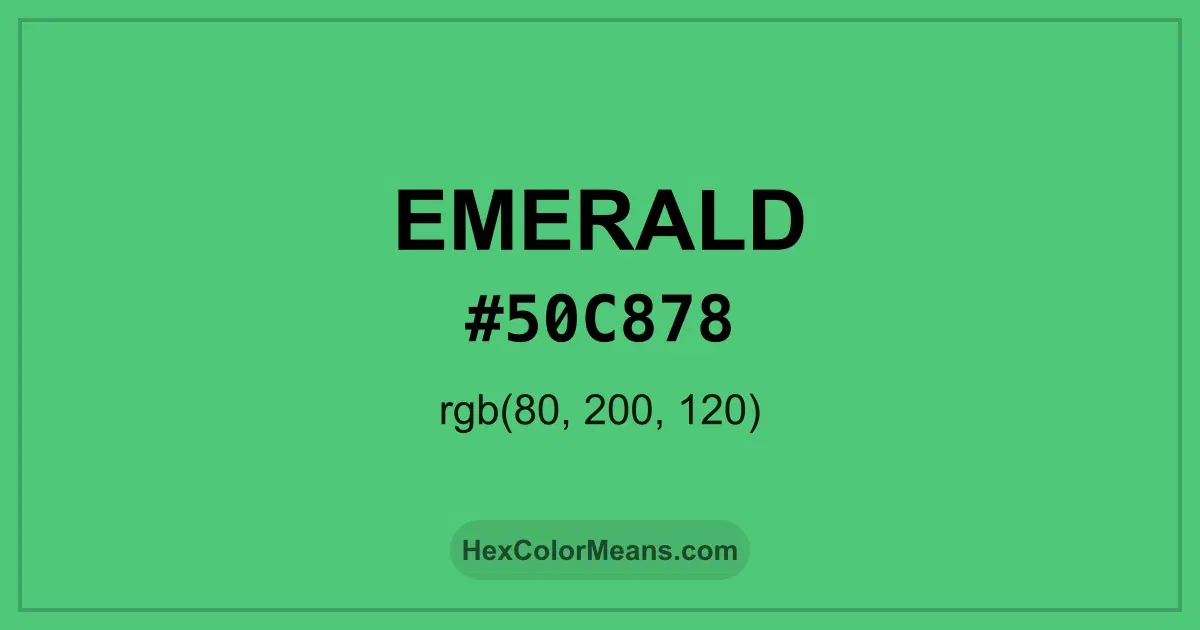
Emerald (#50c878) RGB value is (80, 200, 120). The hex color red value is 80, green is 200, and blue is 120. Its HSL format shows a hue of 140°, saturation of 52%, and lightness of 55%, while the CMYK process values are 60%, 0%, 40%, and 22%.
Colors that pair well with Emerald (#50c878) include Mantis (#74C365), Shamrock (#45CEA2), and Fuchsia (Crayola) (#C154C1), as they maintain visual balance and harmony, whereas Slate Blue (#6A5ACD), Copper Red (#CB6D51), and Fuchsia Plum (#C54B8C) tend to conflict with this color due to strong contrast or opposing tonal characteristics.
Emerald (#50c878) Color Meaning
Emerald (#50C878) is a bright, vivid green with jewel-like intensity, associated with the gemstone of the same name. Its tone conveys luxury, richness, and vitality. Emerald (#50C878) is widely used in jewelry design, branding, and high-end interiors to communicate elegance and prestige. The color signifies abundance, growth, and sophistication. Emerald (#50C878) pairs well with gold, white, and darker greens to create luxurious, balanced compositions. Its vivid saturation ensures visual prominence while maintaining refinement. Pigments for Emerald (#50C878) are traditionally chromium-based or modern synthetic blends to replicate gemstone brilliance. Across cultures, emeralds and their color represent prosperity, protection, and renewal. Emerald (#50C878) merges natural elegance with symbolic richness.
Color Conversion
Accurate conversions of Emerald (#50c878) across RGB, Hex, CMYK, HSL, and Lab ensure consistent color fidelity across digital, print, and design applications.
RGB Values & CMYK Values
Detailed RGB and CMYK values of Emerald (#50c878) displayed in a horizontal bar provide clear reference for digital and print color accuracy.
RGB Channels
CMYK Ink Density
Color Variations
A full range of Emerald (#50c878) variations, including tints, shades, and tones, provides highlights, depth, and subtle desaturated options for UI design.
Color Harmonies
Harmonious color schemes for Emerald (#50c878) created using the color wheel ensure visually balanced palettes.
Analogous
Colors adjacent on the color wheel (30° apart)
Complementary
Colors opposite on the color wheel (180° apart)
Split Complementary
Three colors using one base hue and the two hues beside its opposite
Triadic
Three colors evenly spaced (120° apart)
Tetradic
Four colors forming a rectangle on the wheel
Square
Four colors evenly spaced (90° apart)
Double Split Complementary
Four colors formed from two base hues and the colors next to their opposites
Monochromatic
Variations of a single hue
Contrast Checker (WCAG)
Luminance contrast ratios for Emerald (#50c878) against standard backgrounds ensure readable, accessible text following Contrast Checker and WCAG 2.1 AA/AAA standards.
Sample Text
This is how your text will look with these colors.
Large Text (18pt+)
Normal Text
UI Components
Color Blindness Simulator
Simulated views of Emerald (#50c878) for different color vision deficiencies help identify potential confusion using the Color Blindness Simulator.
Normal Vision
protanopia
Note: These simulations are approximations. Actual color vision deficiency varies by individual.
CSS Examples
Background Color
Text Color
Sample Text
Border Color
Box Shadow
Text Shadow
Sample Text
Gradient
Seamless Patterns
High-resolution seamless patterns featuring Emerald (#50c878) provide ready-to-use backgrounds, wallpapers, and print designs for any project.
Icons
A collection of popular icons in Emerald (#50c878) offers ready-to-use visuals for interfaces, designs, and creative projects.
Real-World Applications
Real-world mockups of Emerald (#50c878) showcase its versatility across fashion, interiors, branding, and product packaging.
Useful Color Tools
A curated set of tools to help apply, analyze, and manage colors effectively in your projects
Emerald (#50c878) Color FAQs
Frequently asked questions about Emerald (#50c878) color meaning, symbolism, and applications. Click on any question to expand detailed answers.